
Every youth coach has had that moment. You stare at the whiteboard, feeling like a general plotting the invasion of Normandy. The beach is a patch of grass. Your troops are ten-year-olds already dreaming of the post-game snack.
The formation is our opening gambit. It’s the political party platform of sports—a clear statement of intent. Is it the strategy itself, or just its most visible costume? I’ve seen a rigid 4-4-2 play like free jazz and a cautious 5-3-2 attack like a blitzkrieg.
This isn’t about dogma. It’s about fluid starting points. We dissect the common formations not as scripture, but as adaptable blueprints. Choosing the right one hinges on your squad’s unique strengths and the need for a solid defense.
Insights from guides on football tactics and tournament game strategy reveal a truth. The real magic begins when your beautifully drawn lines meet the chaotic, beautiful minds of children. The whistle blows. The dialogue with the game starts.
Adapting to Age and Skill
The journey from chaotic swarm soccer to coordinated play is like human growth—messy and fascinating. Your team strategy evolves with each birthday and growth spurt. It’s not a fixed plan but a living guide.
With young players, think of Mary Poppins, not Pep Guardiola. The goal is fun, not complex tactics. Practices for five-year-olds should be full of laughter and learning.
Studies, like those from the Heckman equation research, show early engagement builds skills. These skills are key for later learning.
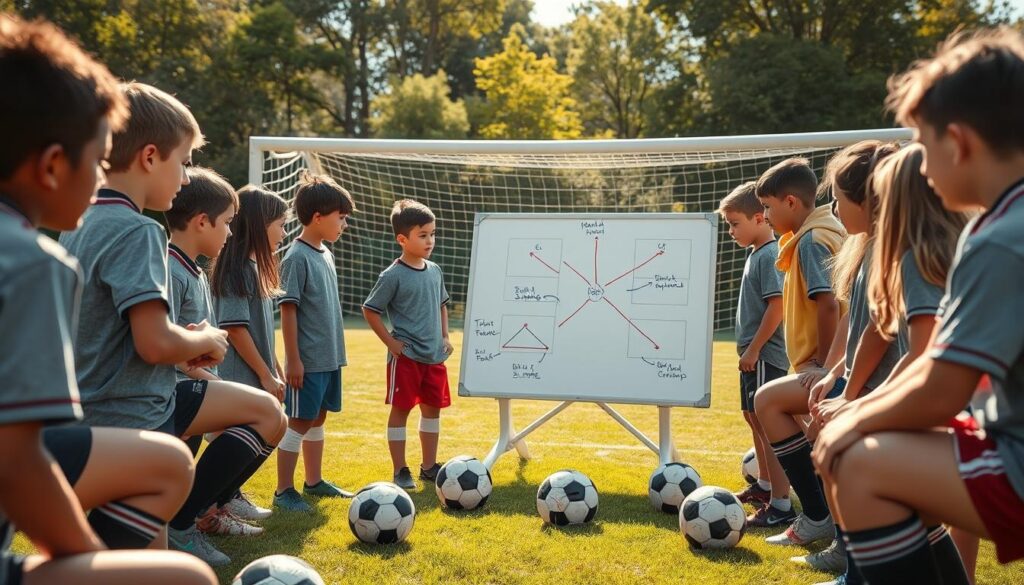
At 8-10 years old, players start to remember teammate preferences. They learn the field’s width, not just its direction. Your coaching shifts from leading to guiding.
Practices need structure and flexibility. Tuesdays might focus on passing, while Thursdays are for creative play. This mix helps skills grow.
Consider this developmental framework:
| Age Range | Primary Focus | Strategic Complexity | Success Metric |
|---|---|---|---|
| U6-U8 | Fun & Basic Coordination | Directional Awareness | Smiles per Minute |
| U9-U11 | Skill Acquisition & Team Concepts | Simple Shapes & Roles | Attempts at New Skills |
| U12-U14 | Tactical Understanding & Problem-Solving | Formational Flexibility | Decision Quality Under Pressure |
Notice what’s missing from that table? Wins and losses. With young players, the scoreboard is less important. What matters most is their effort and joy in trying new things.
At U12-U14, you can introduce complex tactics. But remember, you’re teaching principles, not just rules. This helps players understand, not just memorize.
Research from places like IZA is key here. Their work on skill formation dynamics shows skills grow step by step. Trying advanced tactics too soon is like teaching calculus before arithmetic.
The best team strategy for young players is simple:
- Create environments where mistakes are learning opportunities
- Gradually increase complexity, like turning up a dimmer switch
- Celebrate effort, not just results
- Include moments of free play for creativity
Coaches need to be adaptable yet firm in their philosophy. What worked last year might not work this year. Be open to changing your approach.
Also, talk to parents about their expectations. Explain your tactics in a way they can understand. This helps them see the value in your approach.
The goal is not to make mini-professionals. It’s to create players who love soccer for life. Success is when former players stay connected to the game, even as adults.
That’s true victory. Everything else is just keeping score.
Case Studies of Winning Tactics
Winning in sports often comes down to careful planning. I’ve seen teams with less talent win big because of their game planning. It’s not just about the team’s formation.
Take the team that won last season’s regional cup. They had a secret: a detailed binder. It had scouting reports, hydration plans, and set-piece diagrams. Their coach knew strategy is key, but tactics win games.
This team’s plan included studying their opponents. They knew which forward was left-footed. They practiced scenarios like protecting a lead with time running out. Their game planning was as detailed as a military operation.
This team mixed data with heart. They had team dinners to build chemistry and a consistent warm-up to stay calm. Their success was clear and measurable, like any project’s KPIs.
The main lesson? Winning isn’t random. It’s the result of a game planning process that prepares for everything. When the game starts, the team just needs to follow what they’ve practiced.