
Forget the rah-rah speeches and inspirational posters. Trying to motivate someone is like trying to force a cat into a bath—it’s messy, stressful, and futile. The real game isn’t about pumping people up. It’s about understanding their internal wiring.
As one seasoned coach said, you can’t motivate anyone. You can only help them connect their own drive to the task. This means moving past empty ideas like “fun” or “friends.” Is the fun in the brutal poetry of a perfect tackle? Or is it in the social glue of a post-play chest bump?
To crack this code, we categorize athletes by their primal drive. Meet the archetypes: The Gladiator, a natural competitor who finds drills boring. The Social Butterfly, for whom the team is a mobile friend group. And The Scholar, who gets a genuine high from mastering a skill.
Understanding this taxonomy is the first, key step. It’s how we move from generic platitudes to the specific, visceral imagery that actually fuels. It’s about recognizing the fundamental types of motivation already at play in your group. Let’s ditch the one-size-fits-all hoodie and start tailoring the approach.
Pre- and Post-Game Talks
The pre-game huddle is not just about sharing information. It’s about tuning emotions. Players know the game plan and have practiced. The real challenge is connecting with their personal reasons for playing.
Do you talk to the competitive spirit or the team player? A generic team talk might excite some but not others. The goal is to spark everyone, not just a few.
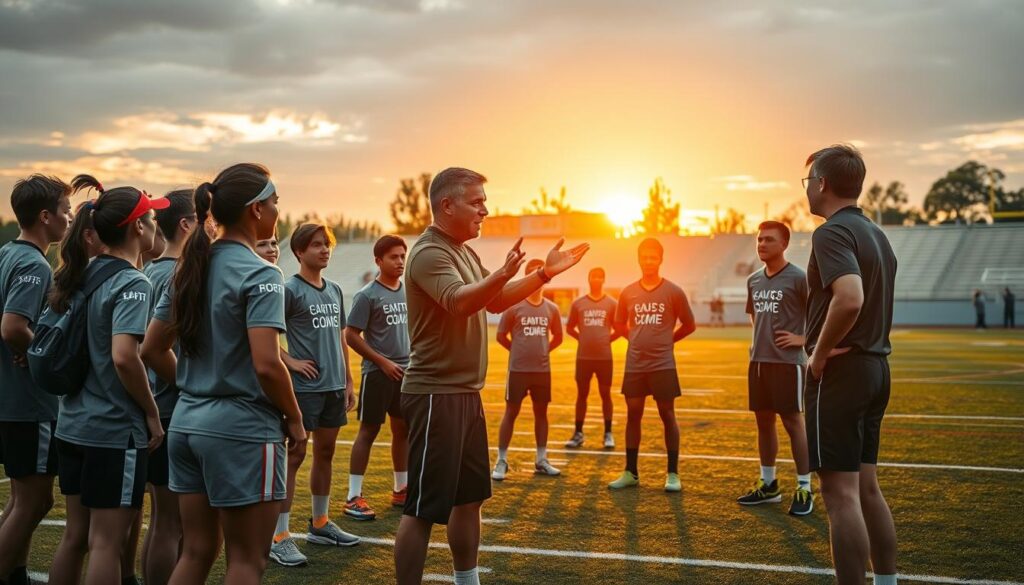
After the game, emotions are high, and logic can be low. This is the toughest time. Harsh words and unfair comparisons can hurt more than help. Shouting corrections from the sidelines is like throwing spaghetti at a wall.
A good coach stays calm and gives clear, timely feedback. They know growth happens in quiet moments, not just in the team’s presence.
This quiet time is for personal growth. It turns criticism into a chance to learn. It’s about finding the gap between what we wanted and what happened. Let’s fix it together.
When motivation wanes, this approach reignites it. It’s not about another speech. It’s about reminding each player of their personal reasons for playing.
So, how do these talks differ? Let’s look beyond the usual phrases.
| Aspect | The Ineffective Talk | The Effective Talk | Core Principle |
|---|---|---|---|
| Pre-Game Focus | Generic hype, fear of losing, last-minute tactical overload. | Emotional calibration, connecting to personal “why,” simplifying to one key focus. | Ignite individual drivers within a team framework. Explore pre-game motivational chats for sport-specific ideas. |
| Post-Game Setting | Loud, public critique immediately after the final whistle. | Calm, team acknowledgment first, followed by specific, private debriefs later. | Critique the performance, not the person. Protect confidence to enable growth. |
| Feedback Method | “You guys were terrible on defense!” (Vague, negative) | “On that drive in the 3rd, our help rotation was a step slow. Let’s watch that clip tomorrow.” (Specific, analytical) | Frame feedback as a solvable problem, not a character indictment. |
| Coach’s Demeanor | Reactive, emotional, yelling corrections during play. | Composed, observational, modeling the focus you demand. | Your behavior is the most powerful part of any team talk. |
The table is about mindset, not scripts. The pre-game talk gets the team ready. The post-game talk helps them improve for the next game. Master these, and your team talks become a real advantage.
Building a Motivational Culture
Think of your team’s culture as its operating system. You can’t just install motivation with a pre-game pep talk. You have to code it into the core. This starts, as any good system does, with the user profile. Knowing your players as people—not just athletes—is the radical first step. Treat them fairly, not equally, in the spirit of coaching legends like Bill Parcells.
The architecture hinges on goals that matter. Blend individual ambition with collective purpose. The most powerful rewards aren’t always shiny. They’re the respect of a teammate, the specific praise from a coach who noticed your footwork improved, the responsibility of helping a rookie. This creates a leadership pipeline where veterans reignite sparks in struggling teammates.
Delegation is your secret weapon. Let assistants and parent helpers remind players of their personal why. Empower your captains. Studies of elite teams show that coaches who partner with steady leaders, like Gregg Popovich did with Tim Duncan, build systems that win for years. You can explore more about these championship communication techniques to see how it’s done.
The final product isn’t a trophy. It’s a self-motivating organism. It’s a culture where the ultimate reward is the pride of having built the machine itself. For a deeper dive into structuring these intrinsic and extrinsic drivers, modern motivation frameworks offer a great blueprint. Your legacy is a team that motivates itself, long after your final whistle.