
Forget the perfect playbook. The real magic happens when the script gets tossed and the whistle blows.
Watching a game is like seeing a movie. Reading the game is like having the screenplay. You see the plot twists before they happen.
This isn’t about reactive panic. It’s a proactive, intellectual exercise. You’re the chess grandmaster, anticipating moves three steps ahead on the court.
Those first few minutes? They’re a data-gathering goldmine. Observing an opponent’s favorite side for a pick-and-roll, or a defensive tell, is often more valuable than any pre-game report. It’s where you learn to read the game like a seasoned pro.
The data doesn’t lie. Close to 90% of successful plays come from quick, smart decisions made in these unscripted moments. Your ability to “read the room”—or in this case, the court—is your most powerful, non-transferable asset. It’s the difference between victory and a story about the one that got away.
Common Situational Adjustments
The best coaches are like editors, making changes in the game as it happens. They’ve figured out the game’s story. Now, they need to change it. This is when tactical adjustments move from the whiteboard to the court.
Let’s talk about tempo. Is the game fast or slow? You’re the conductor. If the game is too fast, you slow it down. If it’s too slow, you speed it up. It’s like changing the music.
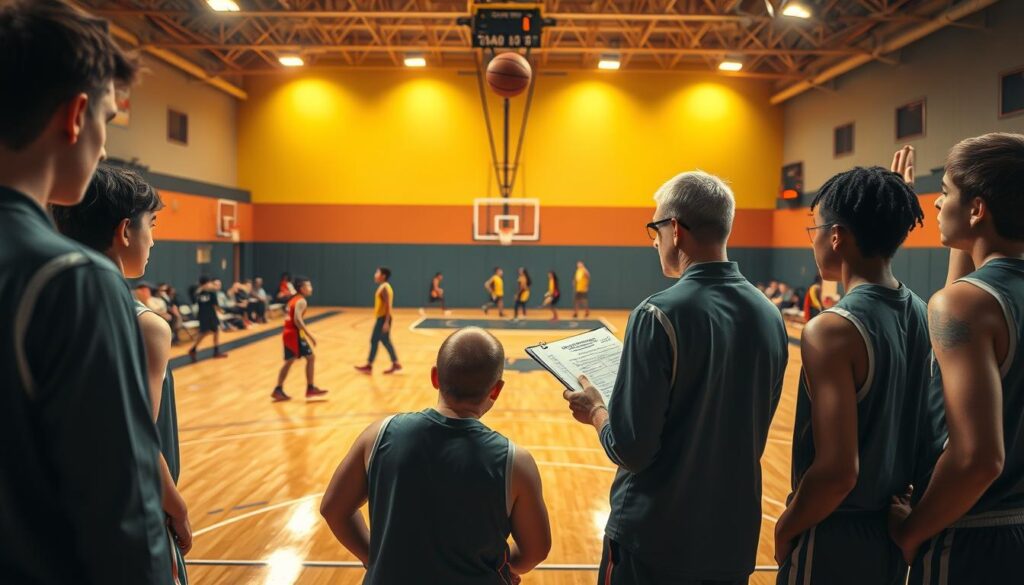
Defense is like a chess match. You don’t aim for perfection every time. You aim for disruption. Switching from man-to-man to zone defense is like changing the scene in a movie.
Targeting a hot scorer? Use a box-and-one defense. It’s like having a serious talk with them. Trapping a ball-handler makes them uncomfortable, leading to mistakes.
Offensively, you react like a chess player. If the defense is too tight, use your star as a decoy. If they deny passes, cut backdoor. These are not just plays; they’re mind games.
Offensively, you make adjustments based on the defense. If they switch, you have a mismatch. If they fight over screens, your roller is open. This constant back-and-forth is key to high-level adjustment strategies.
To make this clear, let’s look at a table of common adjustments.
| Situation Trigger | Defensive Adjustment | Offensive Counter-Adjustment | Desired Effect |
|---|---|---|---|
| Opponent scores 3+ consecutive baskets in transition. | Immediately implement a full-court press or 3/4-court trap to slow inbounding and disrupt early offensive flow. | Use a designated safety (often the center) to hang back, receive a long pass over the press, and create a 4-on-3 advantage. | Break opponent’s rhythm, force a turnover, or eat 8-10 seconds off the shot clock. |
| One opposing player is on a personal scoring run (e.g., 10 points in 3 minutes). | Switch to a Box-and-One or Diamond-and-One defense, denying that player the ball and forcing others to beat you. | Use the targeted star as a decoy in off-ball screens; have secondary scorers attack the seams of the unusual defensive alignment. | Neutralize the hot hand, frustrate the star, and test the opponent’s depth. |
| Your half-court offense is stagnant; too much dribbling, poor shot selection. | N/A (Offensive problem) | Call a set play to initiate movement, or mandate a “pass-first” series (e.g., ball must touch the post or hit 3 players before a shot). | Create player and ball movement, generate higher-percentage shots, and reset offensive discipline. |
| Opponent is exploiting your standard man-to-man defense with effective screening. | Spring a surprise zone defense (2-3 or 1-3-1) for 2-3 possessions to disrupt their play-calling and read-and-react timing. | Station shooters in the gaps (short corners, high post) and use quick ball reversal to find open three-point shots against the shifting zone. | Create confusion, force the opponent to call a timeout to adjust, and potentially generate live-ball turnovers from errant passes. |
The best tactical adjustments are simple but timely. They’re not about creating a masterpiece. They’re about disrupting the game. And sometimes, that’s all it takes to change the game.
Substitution Strategies
If basketball were chess, your rotation would be like swapping a bishop for a knight. This small change can completely change the game. It’s not about giving everyone equal time. It’s about making smart moves to win.
Looking at the bench, I see special tools ready to go. There’s the “defensive stopper” with quick reflexes. The “energy guy” plays with passion. The “zone-buster” can shoot threes from anywhere. Your team is like a movie, and you’re the director making changes.
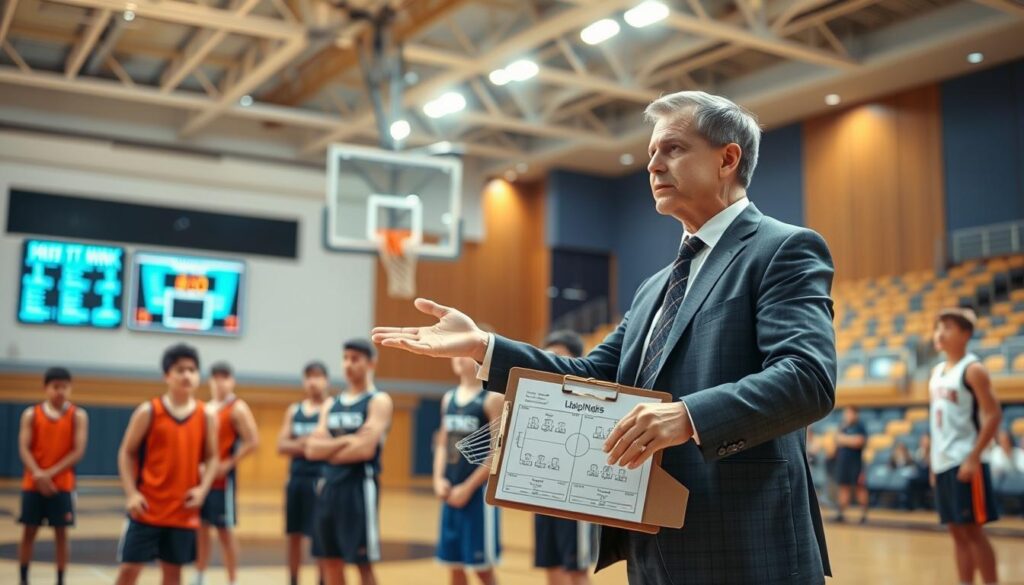
Is the opponent’s point guard getting too comfortable? It’s time to bring in your toughest defender. This move can disrupt their rhythm and find weak spots. Think of it as changing the TV channel to a different story.
The best rotations use specific players for certain tasks. Here’s a look at some common roles:
| Player Archetype | Strategic Purpose | Trigger for Deployment | Psychological Effect |
|---|---|---|---|
| Defensive Stopper | Neutralize opponent’s primary scorer | Star player finding rhythm; offensive sets becoming predictable | Frustration; forces secondary options |
| Energy Injector | Increase pace; disrupt flow | Game slowing down; momentum shift needed | Panic; rushed decisions |
| Zone Specialist | Exploit defensive schemes | Opponent switches to zone defense | Scheme abandonment; defensive confusion |
| Closer | Execute in high-pressure situations | Final minutes; possession-by-possession play | Doubt; hesitation in key moments |
Coaches often overlook the power of bench players. Turn them into junior analysts. They can spot tendencies and help make smart changes. This makes your team more strategic.
Knowing when to make changes is key. It’s like playing a game within the game. This idea works in many sports, like football. The goal is to control the game’s pace by choosing who plays.
Mastering these strategies means seeing time as a tool. A bad rotation is like a DJ who doesn’t get the crowd. But with precision, your team can make smart, strategic moves. For more, check out basketball substitution patterns. The bench is where strategies come to life.
Managing the Scoreline
Coaching is like solving a math problem. The clock is always watching. My secret weapon? Timeouts. Most coaches save them for emergencies. I use them to change the game’s direction.
A timeout can give you a chance to rethink your strategy. It’s not just a break. It’s a strategic move to turn the game around.
Should you call timeouts to reset or just when you’re down? It’s a tough call. But at youth levels, it’s about making smart choices. Winning isn’t always the only goal.
Protecting a lead can be tricky. Trying to hold onto it too long can backfire. Modern strategies suggest playing your best until the end. It’s a delicate balance between being aggressive and holding back.
For more on managing games, check out the BAYS lopsided game guidelines. Managing the game’s spirit is the real challenge.